Graph Data Model
Context-Fabric represents annotated text as a directed graph. Every word, phrase, clause, sentence, and document becomes a node. Features annotate these nodes with properties. Edges encode containment, sequence, and relationships.
This model applies to any structured corpus—biblical texts, classical literature, legal documents, linguistic corpora, or any text with layered annotations.
Slot Nodes: The Atomic Units
Slot nodes are the minimal units of the corpus. In most corpora these are words, but they could be morphemes, characters, or any atomic unit the annotation scheme defines. Slots form a strict linear sequence, numbered from 1 to N.

Slot nodes define textual order. Every other node in the corpus derives its position from the slots it contains. A sentence containing slots 100-150 comes before a sentence containing slots 200-250.
Slot nodes are the only nodes that carry the actual text. All other nodes are containers that derive their text from the slots they encompass.
Non-Slot Nodes: Containing Structures
Non-slot nodes represent structures built on top of slots: phrases, clauses, sentences, paragraphs, sections, chapters, documents, and corpus-specific structures.
These nodes form overlapping hierarchies. A chapter contains sentences. A sentence contains clauses. A clause contains phrases. A phrase contains words. The same word might belong to multiple overlapping structures in different annotation layers.
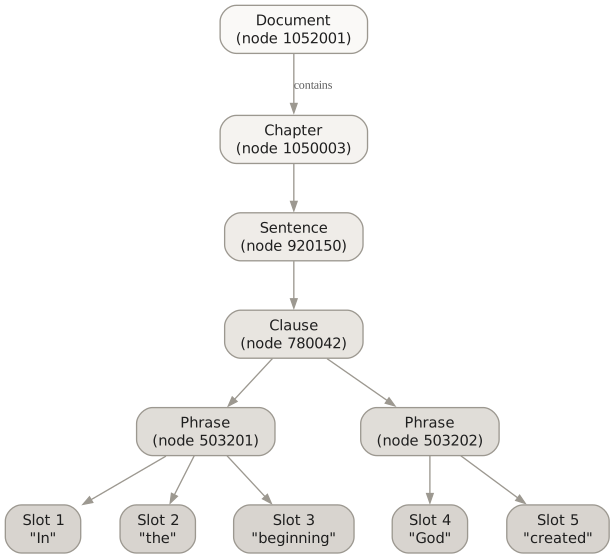
Non-slot nodes receive IDs that continue the numbering after the last slot, grouped by type. If a corpus has 100,000 word slots, the first non-slot type might occupy nodes 100,001–150,000, the next type 150,001–300,000, and so on. Each node type has its own contiguous block of IDs.
Spanning Slots
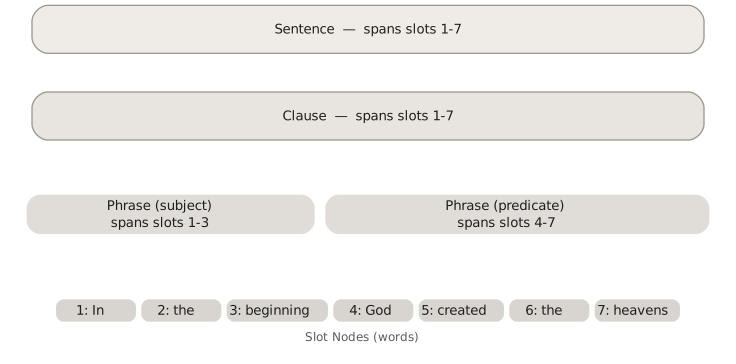
Each non-slot node spans a range of slots. A phrase might span slots 1-3, while the clause containing it spans slots 1-7. This span-based representation enables efficient containment queries.
Node Types
Every corpus defines its own set of node types based on its annotation scheme. Use describe_corpus() to see what's available:
describe_corpus()
# Returns node types like: word, phrase, clause, sentence, paragraph, section, etc.
Example: BHSA (Hebrew Bible)
The BHSA corpus defines types including: word (426K slots), phrase, clause, sentence, verse, chapter, book, plus linguistic structures like subphrase, clause_atom, and half_verse.
Example: Literary Corpus
A novel corpus might define: word (slots), sentence, paragraph, chapter, book.
Features: Annotations on Nodes
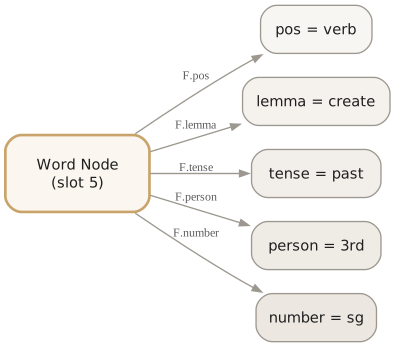
Features are named attributes attached to nodes. They encode whatever the corpus annotates: part of speech, grammatical properties, semantic tags, metadata, and more.
Node Features
Attributes of individual nodes. Accessed via the F API:
# Get a feature value for a node
value = F.feature_name.v(node)

# Find all nodes with a specific feature value
nodes = F.feature_name.s(value)
Common feature types across corpora:
- Lexical: lemma, surface form, normalized form
- Grammatical: part of speech, tense, number, gender, case
- Semantic: gloss, domain, named entity type
- Structural: function, relation, type
Edge Features
Attributes of relationships between nodes. Accessed via the E API:
# Get related nodes via an edge
related = E.edge_name.f(node)
The API prefixes: F for node features, E for edge features, L for locality (containment), T for text, S for search.
Containment and the L API
The locality API (L) answers questions about containment and adjacency:
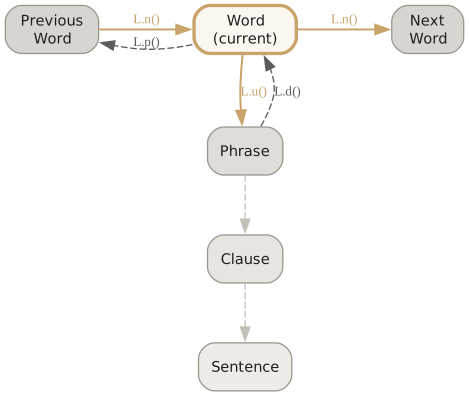
# What words are in this sentence?
words = L.d(sentence_node, otype="word")

# What sentence contains this word?
sentence = L.u(word_node, otype="sentence")[0]

# What is the next sentence?
next_sent = L.n(sentence_node, otype="sentence")[0]

# What is the previous word?
prev_word = L.p(word_node, otype="word")[0]
The locality relationships:
L.d(node, otype)— down: descendants of a given typeL.u(node, otype)— up: ancestors of a given typeL.n(node, otype)— next: following sibling of a given typeL.p(node, otype)— previous: preceding sibling of a given type
Sequence and Ordering
All nodes have a natural ordering derived from the slots they contain:
- Slot position: A node's position is defined by its first slot (ties broken by last slot)
- Containment ordering: A sentence containing slots 1-50 precedes one containing slots 51-100
- Strict sequencing: Search results return in textual order by default
This ordering enables iteration through the corpus in reading order regardless of which node type you traverse.
Why This Model Matters
The graph model enables queries that would be awkward or impossible in flat text:
Structural patterns:
sentence
  clause
    phrase function=subject
    phrase function=predicate
Ordering constraints:
clause
  phrase function=predicate
  < phrase function=subject    # subject AFTER predicate
Feature combinations:
word pos=verb tense=past
Quantification:
sentence
  clause
  clause
  clause    # sentences with 3+ clauses
The graph model makes linguistic structure first-class. It is not reconstructed on the fly from markup or inferred from whitespace. It is the data.
Implementation
Under the hood, Context-Fabric stores the graph as memory-mapped arrays:
- Slot positions: Two arrays (start/end) per non-slot node type
- Features: One array per feature, indexed by node ID
- Edges: Adjacency arrays with optional edge values
This representation enables:
- Constant-time feature lookup
- Efficient range queries for containment
- Memory-mapped access for corpora larger than RAM